
Quilt Backing Yardage Chart: Five Worked Examples
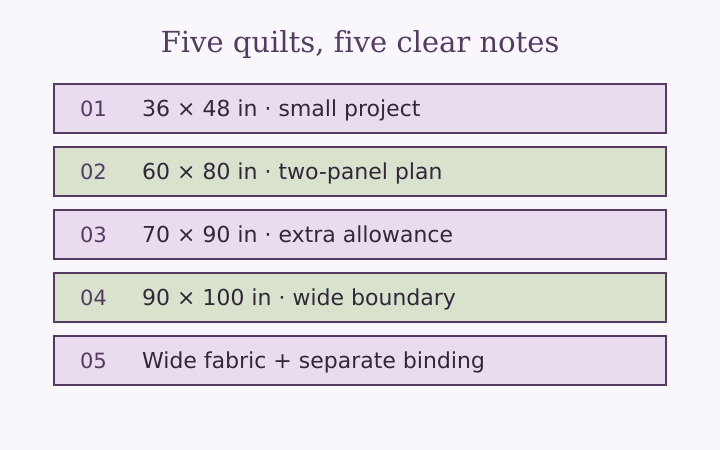
A quilt backing yardage chart is useful only when its assumptions travel with its numbers. The five examples below use specific quilt top dimensions, measured fabric widths and explicit allowances. They are original illustrations of the calculator’s panel method, not a universal standard quilt sizes table. Names such as lap, twin and queen do not guarantee a particular finished quilt dimension. Use the actual top measurements for a purchase decision, especially when borders or a custom drop change the design.
The shared settings behind this chart
Unless an example says otherwise, every top receives four inches of extra backing on all four sides. Fabric has 42 usable inches after excluded edges are removed. Each joined edge uses a half-inch seam allowance. Each panel gets two inches total extra cut length for both ends. There is no percentage purchasing allowance, and the total purchase rounds upward in quarter-yard increments.
Both seam directions are allowed for the main comparison. Vertical seams join panels side by side across the quilt width; horizontal seams stack panels to cover the length. The selected plan has the smaller rounded yard purchase. If rounded purchases tie, the smaller raw cut length is preferred, then fewer panels. A print-direction or quilting restriction overrides that comparison when entered in the tool.
The word usable matters throughout. These are assumed measurements of fictional fabrics, not promises about cloth described as 44-inch or 108-inch material. The arithmetic excludes repeat matching, decorative inserts, width shrinkage, offcut reuse and bias binding. Use the quilt backing calculator to substitute your own measurements and compare its cut list with the examples.
Example one: a 36 by 48 inch small quilt
The required backing is 44 by 56 inches after the four-inch margins are added. Two 42 inch panels joined with half-inch allowances cover 83 inches. Neither target direction fits within a single 42 inch panel, so both arrangements require two panels. The difference is how long those panels need to be cut along the roll.
For vertical seams, each cut is 58 inches: 56 required plus two for the ends. Two cuts total 116 inches, about 3.222 yards, rounded to 3.25 yards. For horizontal seams, each cut is 46 inches: 44 plus two. Two cuts total 92 inches, about 2.556 yards, rounded to 2.75 yards. With both directions allowed, the horizontal plan uses less yardage.
The selected purchase of 2.75 yards does not mean the back will be exactly that length after sewing. It is the roll length needed to obtain two full-width cuts, including the stated allowances and rounding. Label the two 46 inch cuts before assembling. Keep print direction in mind: if horizontal placement is unacceptable, the vertical shopping figure is the relevant one.
Example two: a 60 by 80 inch lap-style project
This example reaches a 68 by 88 inch backing target. Two vertical panels cover 83 inches across and are cut 90 inches long each. Their total is 180 inches, exactly five yards. Three horizontal panels are needed to cover the 88 inch target length; their 70 inch cuts total 210 inches, about 5.833 yards, rounded to six yards.
The unrestricted recommendation is five yards in the vertical arrangement. The extra panel in the horizontal layout explains why simply comparing quilt width and length is not enough. Orientation changes both the number of complete panels and the length of each one. An area-only shortcut cannot express those discrete cuts.
For the complete sequence of entering these measurements and copying a note, see how to use the backing calculator. This example is also a helpful reset check: the tool’s starting values use these same assumptions, so you can compare the default result with the hand calculation before editing a real project.
Example three: a 70 by 90 inch bed quilt
Adding the margins gives a 78 by 98 inch target. The vertical layout needs two panels because their joined span of 83 inches covers 78. Each cut is 100 inches long after the end allowance. The total 200 inches is about 5.556 yards and rounds to 5.75 yards.
The horizontal layout requires three panels, whose combined span is 124 inches and covers the 98 inch target. Each is cut 80 inches long. The resulting 240 inches is about 6.667 yards, rounded to 6.75 yards. Vertical seams therefore use one yard less in rounded shopping length under these settings.
Now add a 5% purchasing allowance to the vertical base as a separate exercise. The raw 200 inches becomes 210 inches of shopping requirement, or about 5.833 yards, rounded to six. The cuts are still two panels of 100 inches; the percentage supplies additional purchase length, not larger nominal panels. Record the percentage so the difference between 5.75 and six yards is understandable later.
Example four: a 90 by 100 inch large quilt
The backing target becomes 98 by 108 inches. Two ordinary-width panels provide only 83 inches, so both directions require three. Three vertical cuts of 110 inches total 330 inches, about 9.167 yards, rounded to 9.25 yards. Three horizontal cuts of 100 inches total 300 inches, about 8.333 yards, rounded to 8.5 yards.
The unrestricted selection is the 8.5 yard horizontal plan. This is a different preferred direction from the preceding examples, showing why a single fixed rule does not work for every top. The calculator evaluates the panel count and cut lengths for the entered rectangle, rather than assuming that the longer quilt dimension must always run along the roll.
A wide-fabric boundary
Suppose the same quilt uses a fabric with 106 usable inches. One panel covers the 98 inch width, so a vertical cut is 110 inches, about 3.056 yards, rounded to 3.25. One panel cannot cover the 108 inch length in the horizontal orientation, despite the fabric being described as wide. Measure the actual span and read the target instead of relying on a category name.
Example five: wide backing plus separate binding
Return to the 60 by 80 inch top, now with 106 usable inches of backing fabric. One horizontal panel covers the 88 inch length, and its cut is 70 inches along the roll. The raw requirement is about 1.944 yards, rounded to two yards. If the print must run the other way, one vertical panel cut at 90 inches needs 2.5 yards instead.
For optional binding, use a separate fabric with 42 usable inches, 2.5 inch cut-width strips, 2.5 inches lost at each join and 12 inches extra for ends and corners. The top perimeter is 2 × (60 + 80) = 280 inches. Adding 12 gives a binding target of 292 inches. Seven strips provide 294 − 15 = 279 inches after six joins, which is insufficient.
Eight strips provide 336 − 17.5 = 318.5 inches after seven joins. Cutting eight strips at 2.5 inches uses 20 inches along the binding roll, about 0.556 yards, rounded to 0.75 yards. The backing purchase and binding purchase remain separate, because their widths and cutting requirements differ. No backing surplus is silently counted as binding.
How to use these examples responsibly
A chart is a comparison aid, not a replacement for your quilter’s requested clearance or your cloth measurements. If a margin, width, seam allowance or end allowance changes, recalculate the complete layout. A small input change may increase the panel count and create a substantial yardage jump. Keep the chosen orientation and purchase increment beside the result.
If an example does not match a number from another chart, compare definitions before deciding one is wrong. Some charts assume different widths, fixed panel counts, larger margins or another rounding increment. The article on yardage mistakes to catch provides a checklist for that comparison. Reliable planning means explaining the difference, then measuring and checking before cutting your own fabric.
Frequently asked questions
Are these standard quilt sizes?
No. These are illustrative measured top sizes. Quilt names and mattress dimensions do not define the actual size of every quilt top.
Why can eight binding strips be needed when seven times 42 exceeds the perimeter?
The target also includes extra length, and each strip join loses length. With the example’s 292-inch target and 2.5-inch join loss, seven strips provide only 279 inches.
Keep the plan with your fabric
Use the quilt backing calculator to make a cut note for your measured top. Confirm the usable width, allowances and print direction before buying. Copy the note, label the fabric and check the assembled back before trimming.
More notes from the sewing table
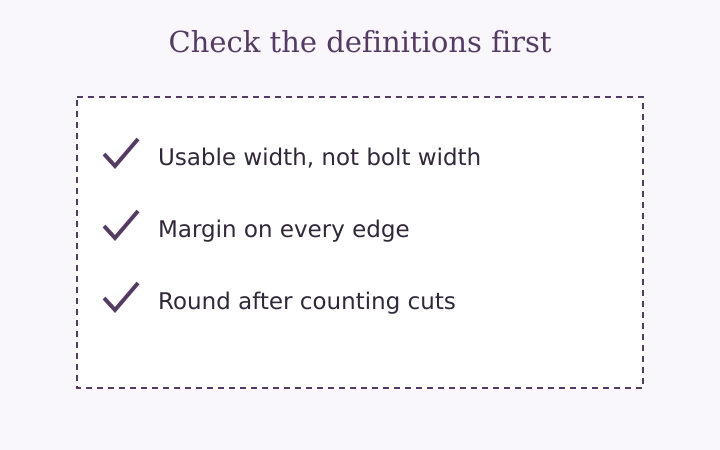
Quilt Backing Yardage Mistakes to Catch Before Cutting
Avoid quilt backing yardage errors caused by nominal widths, missing seam losses, wrong margins, early rounding and unmatched print directions.
Read the note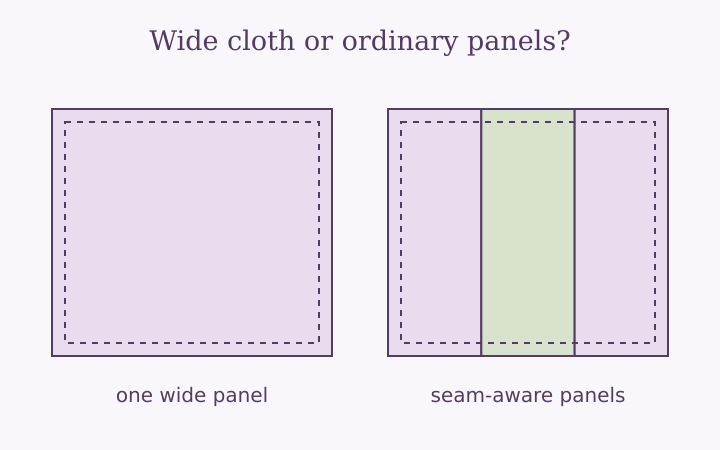
Wide Quilt Backing vs Pieced Panels: Compare the Plan
Compare wide quilt backing with ordinary-width panels using usable width, cut length, seams, print direction and shopping increments.
Read the note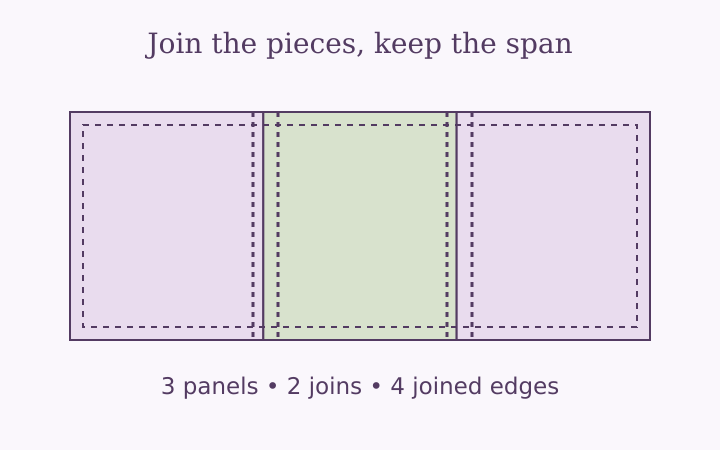
How to Piece Quilt Backing Without Losing Coverage
Learn how to piece quilt backing with usable-width measurements, seam-aware panel counts, orientation checks and a clear assembly note.
Read the note